
Guides
Staying curious when you don't feel like it
17 min read
The short version, first
Three things are true about staying curious:
- Curiosity isn't a performance you put on for your child. It's not asking them a string of gentle questions. It's a quieter thing — wondering, in your own head, what's actually going on for them.
- It changes what you do next, even when it changes nothing else. You might not solve anything. But the half-second of wondering "what's this really about?" is often the gap between reacting and responding.
- It's the first thing to go when your tank's empty — which is exactly why it's worth practising on purpose, for the days you've got nothing left.
That's the short version. Here's what's underneath it.
What's actually going on ▶ listen›
The story comes before the reaction
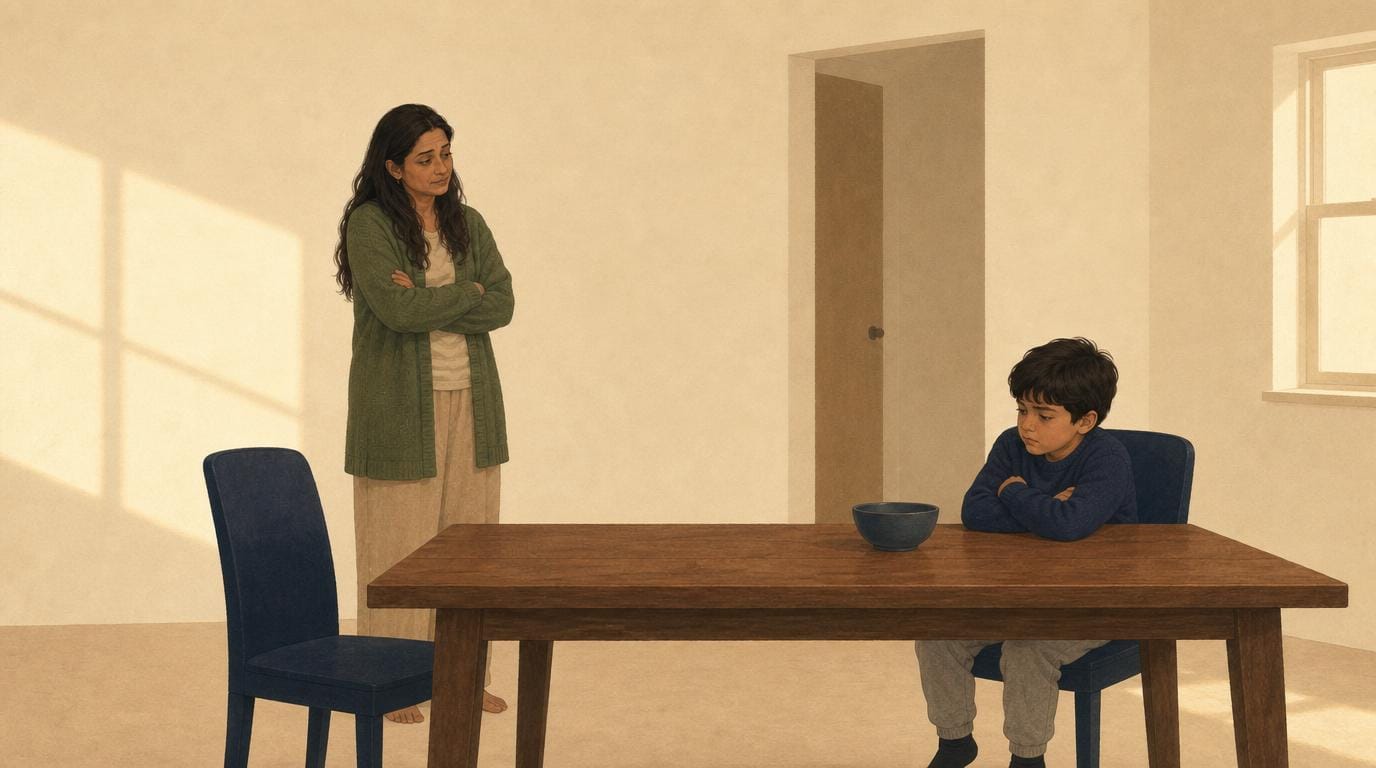
Picture the moment: your kid does the thing. Whines, refuses, slams the door, melts down over the wrong cup. And before you've had a single conscious thought, you already know what it means. They're being difficult. They're doing it on purpose. They're lazy, they're manipulating you, they're winding you up.
Here's the part worth slowing down on: you're not just reacting to the behaviour. You're reacting to the story you just told yourself about it — and that story arrives in a split second, before you've chosen it.
This matters because the story is doing more of the work than the behaviour is. The same slammed door means one thing if the story is "she's being a brat" and something completely different if the story is "she's had a rough day and the door is all she's got left." Same door. Very different next move from you.
The science, if you want it — how we know it's the story, not the behaviour
There's a neat experiment behind this. Researchers took the same child behaviour and told different parents different stories about why it happened — for some, that the child was doing it deliberately, to get at them; for others, that it wasn't the child's fault. Same behaviour; the only thing they changed was the explanation in the parent's head. The parents handed the "they're doing it on purpose" story came down more sharply, and felt angrier. Nothing about the child had changed. Only the story had — and that was enough to change how the parent behaved.
That's one experiment, so hold it as a strong clue rather than the last word — but it doesn't stand alone. A lot of everyday research points the same way: parents who tend to read their child's behaviour as hostile or deliberate tend to come down harder, while parents who give the benefit of the doubt tend to respond more gently — for mothers and fathers both.
Be honest about the edges of it, though. These are mostly patterns, not proof of cause, and the one experiment that did change only the story is a single study — so the safe reading is "the story is doing a lot of the work," not "the story is everything." Plenty else feeds the hard moment too: how tired you are, what kind of day it's been, what the behaviour actually was.
The practical upshot is the hopeful part. Of all the things piling into that split second, the story is the one piece you can actually get a hand on — you can't always stop the first one arriving, but you can refuse to act on it before you've checked it. That check is the whole move this guide turns on. (When the story you've reacted to turns out to be the wrong one, going back to them afterwards mends it — there's more in going back after you lose it.)
Behaviour usually makes sense once you know what it's for
Most difficult behaviour isn't random, and it usually isn't really aimed at you. It's telling you something — I'm tired, I'm hungry, that was too much, I can't do this and I don't know how to say so. This is truest for the big, loud, falling-apart moments: the meltdown, the refusal, the sudden fury. Underneath, there's almost always a reason that would make sense to you if you could see it.
Curiosity is just the habit of asking what the behaviour is for before deciding what it is.
One honest caveat, because the opposite trap is real: not every hard moment is a hidden cry for help. Sometimes a kid is tired, or bored, or testing where the line is today — and that's normal childhood, not a code to crack. You're not signing up to decode everything. You're just leaving a gap before you assume the worst.
A tired brain writes a meaner story
You don't tell the same story at 9am and at 6pm. On a full tank, the slammed door reads as "rough day." On an empty one, the exact same door reads as "she's doing this to me." When you're worn down, your brain reaches for the quickest, harshest story — because the part of you that weighs things up, the driver, is the first thing to run low when the tank's empty.
So if you've noticed your most uncharitable thoughts about your kids show up on your worst days — that's not the real you finally showing through. That's a low tank writing the story.
What "staying curious" actually means here
not a feeling, not a personality type, and definitely not staying calm and wise at all times. It's one small move — leaving a gap between what they did and what you've decided it means — and using that gap to wonder, rather than to confirm what you already assumed.

What changes when ADHD is in the mix ▶ listen›
Curiosity can be harder for three different reasons in the same house: your brain, your child's brain, or both. Pick the one that fits — you don't need all three.
Wondering about someone else takes fuel. It requires you to hold your own reaction back, stay in the moment, and turn something over instead of just firing off the first reaction. That's driver work: exactly the part of the brain that runs low first when you're tired, and the part an ADHD brain burns through faster all day. So the curiosity often isn't there by the time you need it most. That's not a cold heart. It's an empty tank. Most parents are perfectly able to wonder about their kid when they've got something left — the warmth doesn't disappear, the fuel for it does. And there's a knock-on worth knowing: when your own system is steadier, the wondering comes back more easily. So some of "getting more curious" is really "getting a bit less empty" — which is what a lot of the other topics in this library are quietly about.
An ADHD child's behaviour is communicating something more of the time and less obviously. The same outburst that looks like defiance might be too much noise, a change of plan they couldn't ride, or a tank that emptied at school and is spilling out now. The behaviour looks bigger and more "on purpose" than it is — so the curious question (what's this really about?) does more work here than it would with a child whose feelings come out in plainer ways. When their feelings are bigger than you've got left to meet, there's a whole topic on that — it's the hardest version of this.
Then you've got two brains low on the very fuel curiosity runs on, in the same kitchen, at the same time — and the meanest story is the easiest one for both of you to reach for. That's not a double failure. It's the reason the practice that follows is deliberately small and quiet. (Parenting a child whose brain works a lot like yours is its own topic, and one of the more freeing ones — it's worth your time when you're ready.)
What helps — start here ▶ listen›
Start here: you don't have to feel curious. This is the one that trips people up. Curiosity sounds like a warm feeling you're supposed to summon, and on a hard day you won't be able to summon it. Good news: you don't need the feeling. You need the question. You can ask it flat, tired, even a bit sceptical, and it still works. The feeling, if it comes, comes after — usually much later. Treat curiosity as something you do, not something you wait to feel.
There's really one move here, and a couple of ways to make it second nature. Pick whichever fits your house.
Ask one of the three quiet questions ▶ listen›
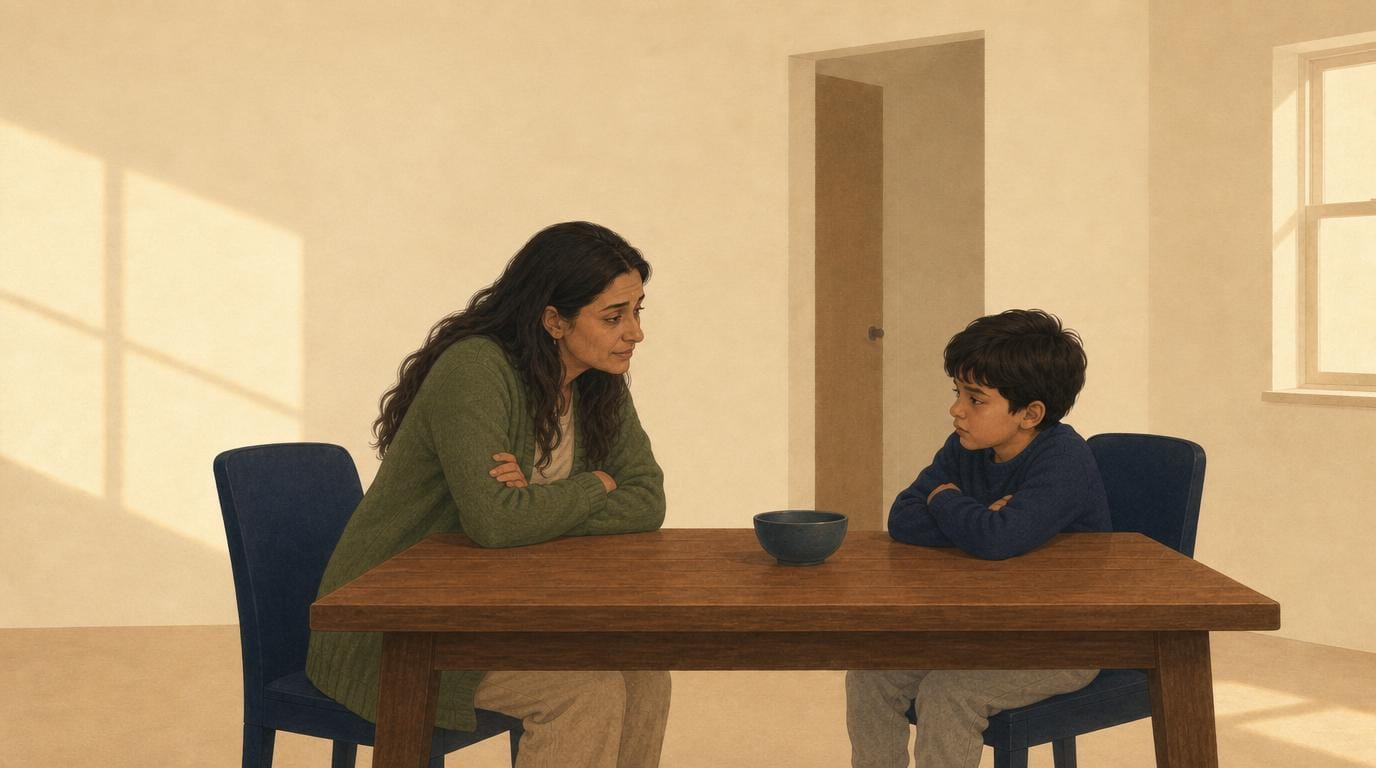
What to try: When your kid does the thing and you feel the old story coming — they're being impossible — ask yourself, in your own head, one of these:
- What might be hard for them right now?
- What is this behaviour trying to tell me?
- What would I see if I assumed they were doing their best with what they've got?
You're not saying these out loud to your child. You're not running all three. You're asking one, quietly, to buy yourself the gap.
What it looks like in practice:
- With a toddler: the wondering is almost all of it — they can't tell you what's wrong, so you're the one quietly guessing. "Tired? Hungry? Too much?" You'll often be right, and even when you're not, you've softened before you've spoken.
- With an 8-year-old: say he's dug in over homework. Instead of "just get it done," you ask yourself what's hard about it first, then turn it into a real question for him, gently: "Something's up. What's going on?" The order matters: wonder first, ask second.
- With a 12-year-old: the question might just buy you a calmer face and a "you alright?" instead of "what is your problem?" At this age, them feeling wondered-about rather than judged is often the whole win.
Why it works: the story you tell yourself drives the reaction that comes out of you. You can't always stop the first story arriving — but you can refuse to act on it before you've checked it. The question is the check. It doesn't make you a calmer person; it just puts a gap where the snap used to be, and gives you a beat to choose the response instead of firing the reaction.
The science, if you want it — why the third question is the strong one
"What would I see if I assumed they were doing their best?" is doing something specific, and of the three it's the one with the most behind it. The harsh story almost always assumes the worst about why — they could behave, they're just choosing not to. Flipping to "assume their best" isn't pretending the behaviour's fine; it's starting from "there's a reason" instead of "there's a fault." That one swap — off a blaming reading, onto a benign one — is exactly the lever the research keeps pointing to: giving a child the benefit of the doubt is tied to gentler responses, and noticing the good they do, rather than only the trouble, seems to protect the relationship over time.
It varies, of course, by how much you've got left. Remember the empty-tank point: a child's best on a low tank can look like a worse kid's ordinary day — their best is still their best, just smaller that day. And your own tank decides how easily you can reach for the kind reading at all; on a flat day it'll feel forced, and forced is fine.
Honest limits, because this is easy to oversell. The exact three questions, in this order, haven't been put through a trial — what's well-supported is the underlying swap, from a blaming story to a benign one, not this particular packaging of it. So treat it as a sound way in that many parents find useful, not a tested formula. And it's a stance, not a magic question: assuming the best doesn't solve the behaviour.
The reason it still earns its place is what it buys you. You're not fixing the moment by assuming the best; you're stopping yourself acting on the meanest version of the story long enough to respond to the child who's actually in front of you — which, when their feelings are bigger than you've got left to meet, is sometimes the only move available. (There's a whole guide on exactly that.)
Make it one question, not three ▶ listen›
What to try: Don't carry all three questions around. Pick the one that fits you and use it until it comes without thinking. For a lot of parents it's the first one — what might be hard for them right now? — because it works on almost everything. One question you actually use beats three you admire and forget.
Why it works: an empty tank can't run a checklist. A single question you've used a hundred times comes back on its own, even when you've got nothing left — the same reason every strategy in this library is deliberately small.
Practise it on the easy days, for the hard ones ▶ listen›
What to try: Don't wait for a meltdown to try this. Run the question on the small, low-stakes stuff — the dawdling, the lost shoe, the hundredth "in a minute." Those are the practice runs. The point isn't that the small moments need it; it's that wondering becomes the thing your brain reaches for first, so it's there when the big one hits.
Why it works: a stance you've practised when it's easy is one you can find when it's hard. Trying to learn it for the first time mid-meltdown, on an empty tank, is the worst possible moment to start.
The science, if you want it — does practising actually grow it?
Honestly: a bit, and slowly. Curiosity here is a skill and a stance, not a fixed trait — and like most skills it does seem to strengthen with use, so parents who keep asking the quiet questions tend to find the first, kinder reading comes a little faster over time. The value is mostly in the practice itself — interrupting the harsh story this time — not in some finish line where you've turned into a permanently serene parent.
How much it grows varies a lot, and depends on the conditions. The gains show up more for parents who get sustained, hands-on support over time than for someone reading a guide once; the brief, do-it-yourself version — which is what this is — is the thinnest slice of all. So set the expectation low on purpose: a little easier, a little faster, not transformed.
Be wary of anyone promising more than that. The honest evidence that practising this kind of wondering changes your child's outcomes is thin, and even where it shifts, the change is small and comes over weeks, not all at once. Anyone selling you a quick turnaround is overselling it.
One thing the research is clearer about, and it cuts both ways: the harsh story tends to pass down — kids of parents who routinely read the world as hostile tend to pick up the same way of seeing. The hopeful mirror of that — a curious, benefit-of-the-doubt stance handing a child a kinder way of seeing — is a reasonable bet rather than a proven fact, but it's a low-cost one, and it's the same muscle either way. So practise it on the easy days, when it's cheap, so a little more of it is there on the hard ones.
Go deeper — the quiet payoff: your kid is watching
Children mostly learn how to treat other people by watching how they're treated. A child who grows up being wondered about — rather than judged on the spot — slowly learns to do the same: to give other people the benefit of the doubt, and to wonder what's going on for themselves instead of deciding they're just bad. You can't teach that with a lecture. They catch it from how you look at them on a hard day.
One honest note on how sure we can be. The clearest evidence here actually runs the other way: the harsh, hostile reading does seem to pass down — a child read as out-to-get-you tends to grow into someone who reads the world the same way. The hopeful mirror — that the curious stance hands a child a kinder way of seeing — is a fair bet built on that, not something that's been shown directly. So hold it warmly but lightly: likely true, not proven.
And it's slow either way. This isn't a lesson learned in a week; it's the drip of a hundred ordinary hard moments, met with a bit more wondering than judgement, over years. Which is the same reason to keep it small — you're not performing curiosity for the lesson, you're just leaving the gap, and the watching takes care of itself.
On the days you can't ▶ listen›
Some days you won't manage any of this. The story will come, you'll believe it, you'll react, and you'll only notice afterwards. That's not the strategy failing. That's a tank too empty to run it — which is information about your day, not a verdict on you as a parent.
Two things help on those days. First: you can come back to it after. "I think I read that wrong earlier — rough afternoon?" works even hours later, and your kid learns something useful from watching you reconsider out loud. (When you've actually snapped, not just misread — going back to them after you lose it is its own topic, and it matters more than getting it right first time.) Second: notice which days the curiosity goes missing. Nine times out of ten it's the empty-tank days — and that tells you the fix isn't "try harder to be curious." It's "find a way to be a little less empty."
Your first week ▶ listen›
Don't try to overhaul how you see your kid. Truly — don't.
This week: pick one of the three questions. Just one. Use it on the small stuff — the dawdling, the whining, the dropped shoe — where the stakes are low and you've got a bit of room. You're not trying to fix anything. You're just getting the question worn in.
When it starts coming on its own (for most parents, a week or two): let it show up in a slightly harder moment. Still just the one question. Still just a gap before you decide.
That's the whole assignment. A stance you can actually find beats a perfect one you can't.
Questions parents ask ▶ listen›
Isn't this just making excuses for bad behaviour? No — and it's worth being clear why. Understanding why something happened isn't the same as deciding it's fine. "There's a reason he hit his sister" and "hitting his sister is okay" are two completely different sentences. Curiosity tells you what to do about the behaviour — meet the tired kid differently than you'd meet the defiant one — without pretending the behaviour didn't happen. Excuses end the conversation. Curiosity starts a more useful one.
What if I'm genuinely sure they're doing it on purpose? Sometimes they are — kids do test, push, and wind us up on purpose; that's real. But "on purpose" still has a reason underneath it. A kid pushing a boundary on purpose is usually checking whether the boundary's still there, or whether you've got enough left to hold it. "On purpose" isn't the end of the wondering — it's just the first layer of it.
Do I have to say the questions out loud to my child? No. This is the bit most people get backwards. Staying curious isn't an interview. The questions live in your own head — they're there to change your read, not to be performed at your kid. With an older child you might turn the wondering into a gentle "what's going on?" once you've softened. But the private version, in your head, is the whole engine.
It feels fake — like I'm just talking myself out of being annoyed. That's roughly what's happening, and it's fine. You're not faking a feeling; you're choosing not to act on the first story before you've checked it. The annoyance can stay. You're just not letting it write the next thing you say. Over time the checking gets faster and the first story gets a bit kinder — but at the start, "going through the motions of wondering" is the real skill, not a poor substitute for it.
If it's bigger than this
Everything here is about ordinary hard behaviour in ordinary tired families. If what's happening in your house feels bigger than that — if you can't find any warmth for your child and it frightens you, if their behaviour scares you, if you're worried about your own state or anyone's safety — that's beyond what a guide should try to hold, and it deserves real support. In Aotearoa New Zealand, you can call or text 1737 any time, free. Anywhere else, findahelpline.com will find the right number for where you are. Talking to your doctor is a strong first move either way.
Before you go
Curiosity isn't a personality you were or weren't born with. It's a small, repeatable move — leaving a gap, asking one quiet question, refusing to act on the meanest story before you've checked it. You won't manage it every time, and you don't have to. The days you can't are usually just the empty days. Tomorrow, on something small, try the one question. That's all. We'll build from there.
Quick check
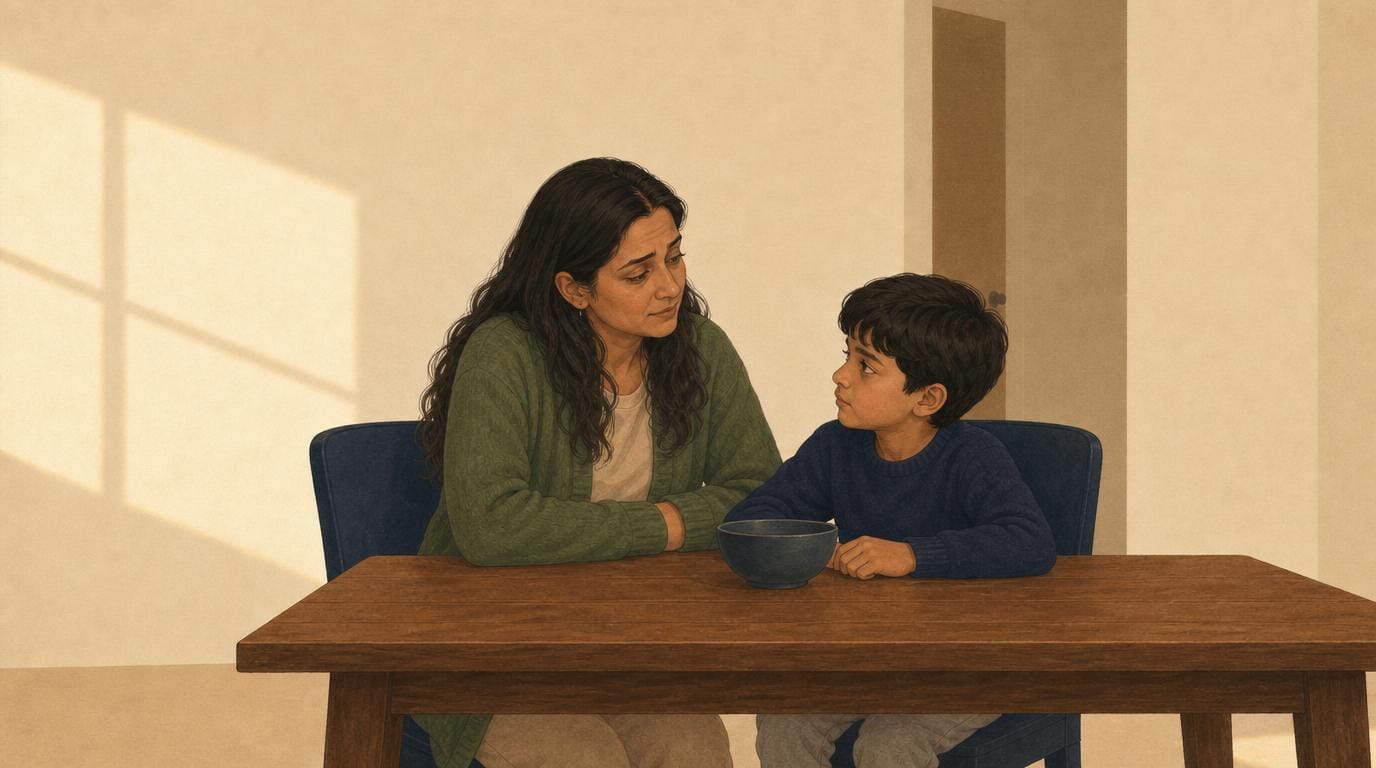
What is staying curious, really — asking your child a lot of questions, or wondering in your own head what's underneath what they're doing?
Show the answer
Wondering in your own head. Curiosity isn't an interrogation; it's pausing to ask what might be underneath the behaviour — is this a won't, or a scared? — before you respond to the surface of it.
Pocket cues
A few keep-worthy lines from this module. Save the one that fits to your phone, so it can catch your eye on the ordinary days. It’s not there to reach for mid-meltdown — sitting in front of you when things are calm, it slowly takes the place of your old reaction.


The evidence behind this — for the curious
We keep the research out of the guide itself and write in plain language. But none of it is made up — here are the main sources behind this one, and how strong each is.
Off Script Parenting is coaching and education — not therapy or diagnosis. Sometimes the evidence behind a guide is strong and well-established; other times it’s still emerging. We factor that into how we shape our guidance, and we keep reviewing and improving it as the research develops.
Found this useful?
This is one of our free guides. The full library goes deeper on every hard moment — a guide for each one, in plain language, with new ones added over time. Or get one small idea in your inbox, every other Tuesday.